
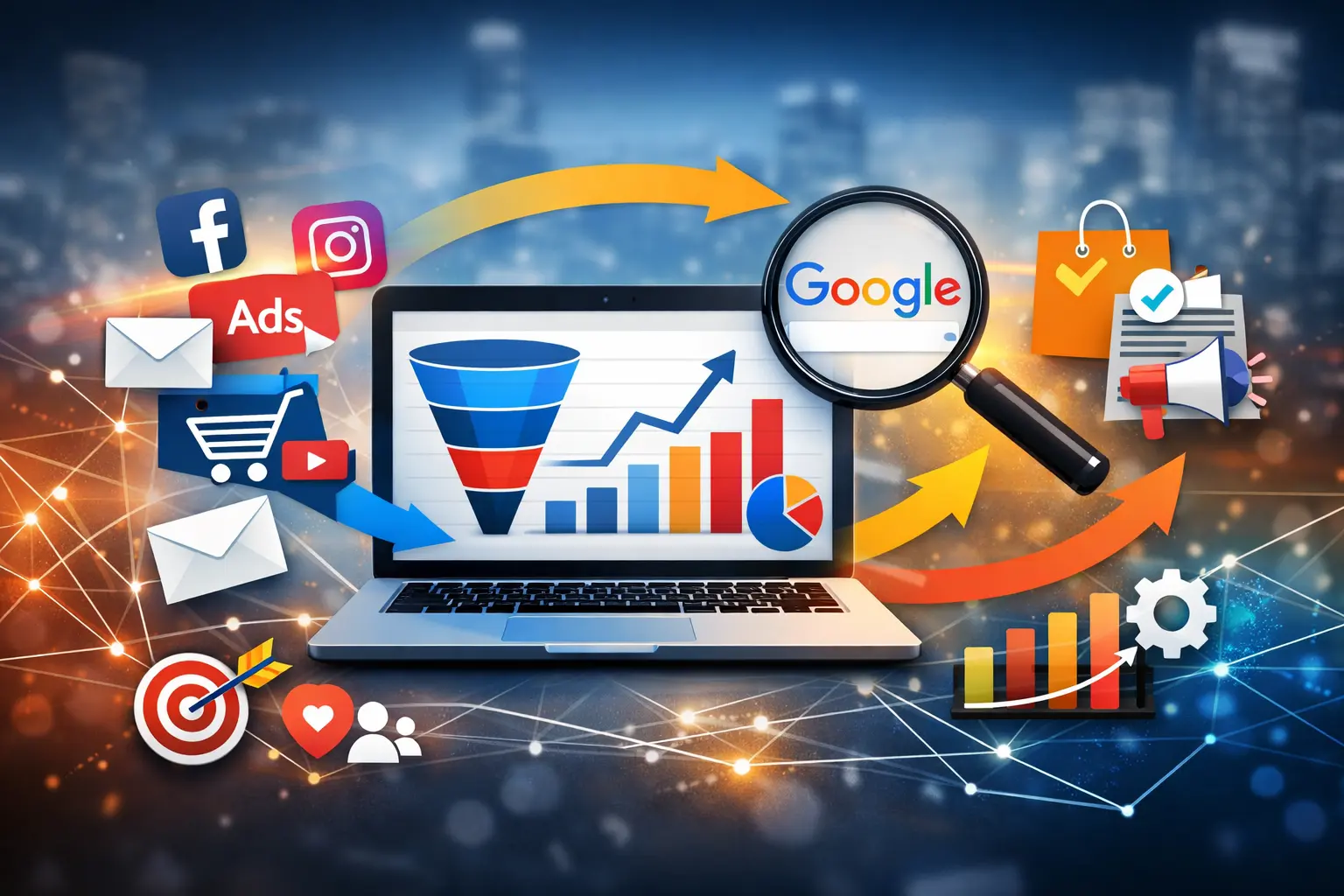
A digital media plan goes beyond the classic channel list. It is a system of levers that work together to take a person from “I don’t know you” to “I choose you”.
Basically, it often happens that channels are activated in a shattered way: a social campaign on one side, a bit of Google Ads on the other, some SEO activity sometines. In these cases, each initiative makes sense individually, but an overall design is missing.
It’s a dynamic I’ve seen on several e-commerce projects: campaigns that are active on multiple channels, but without a real link between discovery, search and conversion. Almost always the result was something more subtle than an obvious failure, that is poor performance compared to potential.
Un piano media digitale efficace nasce quando si passa da una logica tattica a una logica sistemica e ogni canale ha un ruolo, ogni interazione ha un senso, ogni fase prepara la successiva. In questa guida trovi un framework chiaro per costruirlo.
What a digital media plan really is
When we talk about a digital media plan, we often think of an Excel file with budgets, channels, dates, KPIs. In reality, that is only the operational level. The real plan is what lies underneath.
It’s a strategy that decides how to distribute attention, investment, and message along the user journey.
To better understand it, just change perspective: people do not live the channels, but live experiences. They don’t think they’re coming in from an SEO channel or that they’re clicking a display. They live a sequence of contacts that build perception. A digital media plan is exactly what you need to design that sequence.
When this sequence is designed, the reading of the results also changes completely. It is no longer the individual campaign that is evaluated, but the contribution of each touchpoint along the way.
And to do so it must hold together:
- business objectives, which define the direction;
- real behaviors, which are often less linear than one imagines;
- phases of the funnel, which help to bring order;
- data, which allow us to correct the shot.
Without this structure, even good campaigns remain isolated episodes.
The main channels of digital marketing
To make sense of channels within a digital media plan, it’s helpful to read them based on the role they play in the user journey. Not all channels do the same thing. Some serve to generate attention, others to intercept demand, others to build relationships or trust. This distinction allows you to understand not only which channels to use, but above all when and why to include them in the plan.
Channels of attention
The first phase of a digital media plan is about discovery. This is the moment when a user keep in touch with the brand without actively looking for it.
This is where those channels capable of generating visibility and presence get in the game, working on exposure and memory
Among the main channels of attention we find:
- social ads;
- display ads;
- videos;
- influencers.
These tools have a fundamental characteristic in common: they operate in contexts in which the user is not in search mode, but in fruition mode. They don’t have to sell directly, but make a brand memorable and interesting. This is the logic behind the YouTube series Bolaffi Stories that has contributed to the construction of the notoriety of a historic brand of Italian collecting.
For this reason, the message must be immediate, relevant and capable of interrupting the flow. Within a digital media plan, these channels build the first level of contact. This is what happens, for example, when a user sees social or video content several times and, even without interacting immediately, begins to recognize the brand in the later stages of the journey.
Channels of intention
After the discovery phase, a completely different moment get in the game, that of active research. In this phase, the user explicitly expresses a need.
The role of the digital media plan is to be found at the exact moment when that demand emerges.
The main channels of intention are:
- search ads;
- SEO;
- marketplaces.
Here it is no longer a question of attracting attention, but of responding as pertinently as possible to a concrete request. These channels are often the closest point to conversion, because they work on an existing interest and a specific search intent. At the same time, they are also the most competitive, precisely because they concentrate an already conscious demand.
For this reason, in an effective digital media plan, their management requires precision. Keywords, content and offer must be perfectly aligned with the user’s intent. In many SEO projects, it is evident that a large part of the traffic and conversions comes from already very specific queries, a sign that the user has entered an advanced stage of the decision-making process. Managing important online magazines for Italiaonline, I brought most of the total traffic to articles that answered queries related to problems to be solved or needs to be satisfied.
Channels of relationship
Once the contact has been acquired, the digital media plan enters a more evolved phase, that of the relationship.
Here, the goal is no longer just to generate traffic or immediate conversions, but to build continuity over time.
Key channels of relationship include:
- email;
- CRM;
- app / push.
These tools make it possible to move from a “single contact” logic to a relational logic, in which each interaction can be personalized and developed over time. Email marketing, for example, allows you to maintain a direct and constant dialogue. CRM organizes and enhances data, making it possible to communicate more relevantly. Push notifications and apps introduce an even more immediate dimension. Even simple automated flows, such as post-visit emails or cart recovery, can have a significant impact on conversions compared to a strategy focused only on acquisition.
Within a digital media plan, this phase is crucial because it reduces the dependence on paid channels and increases the value of each acquired user.
Channels of trust
Finally, there is a dimension that is often underestimated, but which has a decisive impact, trust.
At this stage in the journey, the user has already discovered the brand, shown interest and evaluated the offer. The question that remains is only one: is it the right choice?
The channels of trust that have the greatest impact in this phase are:
- digital PR;
- media coverage.
These tools act on a different level than other digital marketing channels, because they do not depend directly on brand control, but rather on authority built over time and good press office and digital PR work. A mention in an authoritative media, an article, an external mention have a much higher specific weight than any promotional message.
Within a digital media plan, these channels strengthen trust and increase the likelihood of conversion, while also influencing the performance of other touchpoints.
How to choose channels in a digital media plan
Choosing marketing channels is not a technical exercise, but a strategic decision. And like every strategic decision, it requires clear criteria.
Choosing channels based on goals
Every channel is created to do something well, not everything. The problem arises when you ask a channel to do what it is not designed for, such as using awareness campaigns to generate immediate sales, or entrusting SEO with building the brand in the short term.
An effective digital media plan starts with a simple question: what is the result I want to achieve? And then he builds the choice of channels around that. This avoids dispersion and aligns expectations.
Choosing channels based on funnel
The decision-making process is not linear, but has recognizable phases. A person discovers something, deepens, evaluates, decides. Each step requires a different type of content and pressure. To speak to everyone in the same way is losing effectiveness.
A digital media plan must instead tailor each message, format, and channel to the user’s level of awareness. This is where true consistency is built.
Choosing channels based on budget
The budget does not only define how much to do, but above all how to do it.
With limited resources, the priority is concentration: few channels, but well controlled. This means overseeing demand (search), activating an acquisition channel (social), starting to build relationships (email). Instead, with larger budgets, you can work on depth: more touchpoints, more frequency, more coverage. The difference is not in the number of active channels, but in their ability to work together.
How to integrate digital channels within a media plan
In the integration between marketing channels , the real difference between a plan and a sum of activities is at stake. The channels do not work in parallel, but in sequence.
A user can see content on social media, search on Google, visit the website, be hit by a display campaign, receive an email communication, then return and convert. This route is not random and can be designed.
Integration stems from two main levers: sequence and data.
Sequence
Every channel must be thought of as a logical step in the path and not everything has to happen immediately. The sequence serves to build progression.
Data
Every interaction produce information and data. Using them means making the plan smarter over time. This is where remarketing, personalized audiences, and CRM get in the game.
A user who has already interacted should not be treated as a new one and an effective digital media plan can reduce dispersion, increasing relevance.
The most common mistakes in a digital media plan
Some mistakes in the media plan are not obvious, but they have a strong impact.
One of the most frequent is fragmentation, which consists of many correct, but disconnected, activities. The result is a widespread but not very incisive presence.
Another mistake is the lack of dialogue between channels. SEO, ADV and CRM often work as separate worlds, losing important synergies.
The value of data is also often underestimated. Without an integrated reading, every decision remains partial and a lot of potential is lost.
In the end, there is a cultural theme. It’s about focusing on the tools instead of the system. It’s a subtle but decisive difference, which can limit the effectiveness of tasks that are technically flawlessly executed.
From channel selection to system construction
A digital media plan works when it stops being a set of tasks and becomes a system.
Channels should not simply be activated, but orchestrated: each with a clear role, at the right time, with a message consistent with the user’s phase. The point is not to be present everywhere, but to build a path that makes sense.
Because in the end it always happens that the user does not live your media plan, but his path. And that path can be random or designed.
If you’re working on a digital media plan and you feel like your channels are working, but not as well as they could, it’s probably not what you’re doing, but how you’re putting it together. It is precisely on the ability to read and design the system that today the difference between simply correct activities and truly effective strategies is played.