
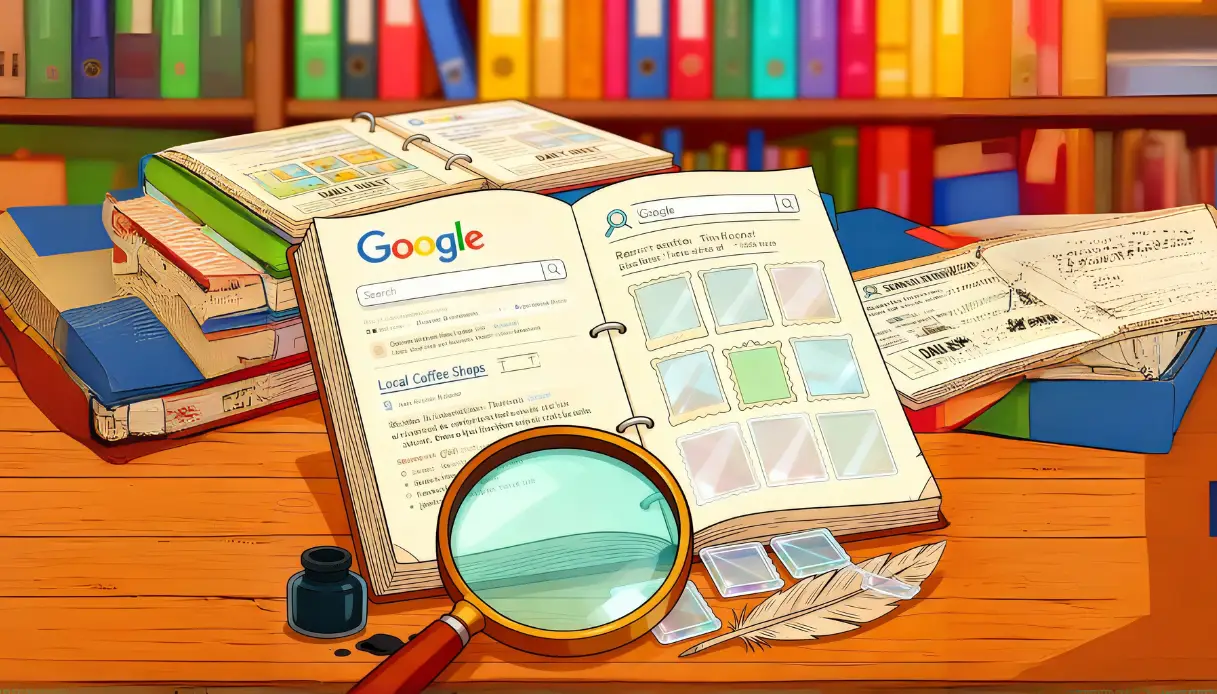
Google collects information on the web, classifies it, enriches it with attributes, relates it and finally organizes it into semantic and conceptual sets. Actually, it builds an orderly system where everything finds a place and meaning. In short, Google is the universal catalog of what exists online.
This idea of catalog has been with me for years. I have worked in two Italian companies that have made cataloguing their essence. First in the Yellow Pages, which since 1965 has been publishing Italian telephone directories, a gigantic catalog of addresses and telephone numbers of companies and individuals. Then in Bolaffi, which since 1890 has been publishing catalogs of stamps, coins and collectibles, telling their value and history.
It was there that I’ve learned what it really means to build a catalog, choose criteria, give order, create logical paths. And there I met Alberto Bolaffi, a man of great culture and charisma, a passionate collector and tireless volcano of ideas. In his way of cataloguing and telling, there was already an anticipation of what Google does today.
In an era where email and WhatsApp have downsized traditional mail, a catalog of stamps can still teach us a lot about the principles behind the Mountain View algorithm.
From attributes to Knowledge Graph
Every catalog starts with a tab. Let’s take a stamp. It is never just a rectangle of paper, but a set of attributes that define it: year of issue, circulation, perforation, color, country of origin, face value. Without these elements it would not be recognizable or comparable with others.
Google thinks the same way. Each entity (a person, a place, a company, a work of art) is described by precise attributes. A person, for example, is associated with age, profession, nationality, published works, presence on social media. This set of structured data constitutes the Knowledge Graph, the system with which Google gives shape and consistency to information.
Just like a catalog, which makes each object unique and describable, Google also builds its intelligence on the art of attributing and ordering characteristics.
From catalog number to canonical URL
A catalog would not be useful without an identification system. Collectors know that each stamp has a universal reference number, allowing anyone to recognize it unambiguously.
Similarly, Google uses a system of unique identifiers: the canonical URL of a page or the internal ID with which it classifies an entity. Behind every result that appears in the SERP there is a key that defines its digital identity.
It is as if each web page had a catalog number that establishes its existence and position in the universal index.
Taxonomies and categories
No catalog could work without logical hierarchies. In philately, stamps are sorted by country, then by historical period, then by series, down to the single piece.
Yellow Pages, to stay with another concrete example, organizes companies by categories and subcategories (restaurants, plumbers, lawyers), so that each activity can find its place and be traced.
Google is not different. It collects entities and inserts them into taxonomies that allow the algorithm to understand relationships and belongings. An online bookstore is not only a store, but it is also part of the “e-commerce” category, the “books” subcategory and linked to products, reviews, authors. The strength of the search engine lies precisely in being a gigantic classification tree, dynamic and constantly updated.
Normalization and standards
A catalog requires consistency. You can’t write “dark blue” in one card and “midnight blue” in another to indicate the same color. We need a univocal and standardized language, otherwise comparison becomes impossible.
The same happens with Google. To work, it imposes standards such as schema.org and structured data, which standardize the representation of information. It is this normalization that allows the search engine to read millions of different pages in a consistent way.
The algorithm is basically a tireless editor that corrects, simplifies and brings information back to a shared format, so that it can talk to each other.
Information enrichment
Catalogs are not just lists. A good stamp catalog does not just show images and face values, but adds historical notes, curiosities about issues, details about variants. It is this information enrichment that transforms a simple list into a tool of cultural value.
Google works the same way. It is not satisfied with returning links, but builds cards enriched with images, reviews, maps, FAQs, knowledge panels.
The user experience becomes more complete and immersive, just like that of the collector who does not consult a catalog just to find out how much a stamp is worth, but to discover connections, stories, contexts.
Relationships and links
A catalogue links from one card to another, indicates variants, indicates subsequent series, creates connections. In this way it builds an internal network of meanings that guides the reader.
Google applies the same principle on an infinitely larger scale. Internal links, backlinks, semantic correlations, and search suggestions are his way of weaving connections. In other words, Google is the digital and enhanced version of the analytical indexes and cross-references typical of catalogs, capable of bringing out links that would otherwise remain hidden.
A catalogue must be updated with each new issue, each price correction, each discovery of a rare variant.
The same happens with Google, which constantly updates its index with continuous crawling and operation with Core Updates.
But there is another fundamental aspect: the authoritativeness of the sources. In a publishing catalogue, credibility comes from experts, collectors, recognized curators. At Google, authority is evaluated by the algorithm with criteria such as E-E-A-T (expertise, experience, authority, reliability), which decide whether a piece of information deserves to emerge.
From research to sale
A catalog is a tool designed for practical use. Those who consult a stamp catalog want to know if a piece is authentic, how much it is worth on the market, what variants exist, while those who browse the Yellow Pages look for a plumber available, a restaurant in the area, a reliable professional. In short, the catalog has always been a compass for orientation, decision-making and concluding concrete actions.
Google has the same vocation, just increased on a global scale. It does not just show information, but facilitates comparisons, suggests alternatives, allows you to buy, book, reach a place. This is what makes it the universal catalog of daily decisions, a living system that guides millions of personal and professional choices every day.
A universal catalogue for the present and the future
In conclusion, Google is but the largest catalog that has ever existed. A dynamic, global, continuously updated catalogue that collects and organizes every fragment of information available online. Like any catalogue of the past, it is based on traditional editorial principles: attribute, order, classify, enrich, relate.
This is where the lesson of the past becomes precious. Just like it has been with Bolaffi’s catalogs or the Yellow Pages lists, Google also built its own orderly encyclopedia, presented to the world in 2012 as the Knowledge Graph. Visionaries such as Alberto Bolaffi or the first editors of the Yellow Pages had already sensed that true strength lies not only in owning information, but in knowing how to organize it.