
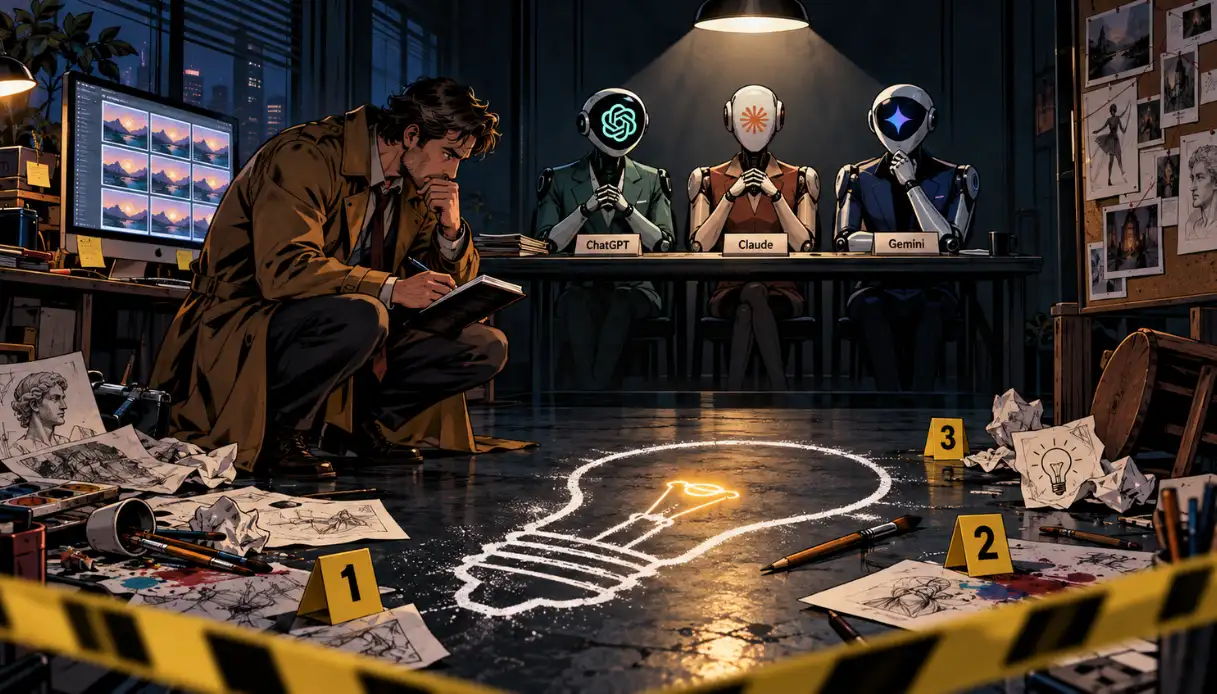
The mangled body was found in front of a computer. On the screen, dozens of headlines, images and slogans generated in a few seconds. No sign of a scuffle. The victim, according to the first reconstructions, would be creativity. Artificial intelligence is the main suspect.
The case seems solved. A machine has learned to do what we paid people for. But before closing the file, it is worth questioning witnesses and looking better at the evidence.
The victim: creative work
Copywriters, illustrators, graphic designers, journalists. When a tool produces texts and images with a few commands, the question inevitably comes. How long will it be before someone decides they can do without us?
The fear concerns income, but also identity. Years spent studying, experimenting and building a professionalism suddenly seem compressible into a text box.
Dismissing this concern with a "just update yourself" is too convenient. A competent professional can lose assignments because a client considers a cheaper result sufficient. Quality matters, but there must be someone willing to recognize it and pay for it.
The first finding of the investigation: the fear is legitimate. The loss of a job does not automatically demonstrate a lack of talent.
The motive: produce more, spend less
The motive is credible. Why pay a person, wait for a proposal and discuss it, when a chatbot offers twenty alternatives immediately?
AI makes sccessible tasks that previously required time, budget, and expertise. For many companies, it's a real opportunity. The problem arises when speed becomes the only criterion for evaluation.
Generating twenty slogans and choosing the right one are different activities. The second requires knowing the audience, understanding the positioning and recognizing a promise that the company can keep. However, if the brief is reduced to "write me something catching", the result risks being judged only by how much it costs. And the professional enters a competition that is difficult to win.
The tracks: homologated and identic content
The imprints are recognizable: recurring formulas, interchangeable images, perfect articles that always seem to tell the same thing. It is here that the suspicion of homologation takes shape.
LLMs learn regularity from large amounts of data. If many people ask for similar proposals and accept the first few responses, they can end up posting content that is very close to each other. A study on short stories observed precisely this tension: AI assistance can improve individual creativity while reducing the overall diversity of stories.
Then there is a second risk, that of the AI-generated material that feeds the training of other models. Research on model collapse shows how the indiscriminate use of this data can cause variety and information to be lost. It is a risk related to training, not an automatism of every response.
But can we recognize a work generated by AI? Repetitions, generalities and inconsistencies suggest verifications, without constituting evidence. Humans also write predictable texts. The case of Thélyson Orélien proves this. The novel "C'était ça ou mourir", winner of the Fnac prize, was excluded from the Goncourt selection after accusations of AI use and plagiarism. The author denied the use of AI, but the detectors returned conflicting results. Suspicion is not enough to establish who wrote a work.
The suspects: ChatGPT, Claude and Gemini
ChatGPT, Claude and Gemini sit in the interrogation room. They respond politely to the investigators' questions, sometimes with an all-too-accommodating availability. They have impressive capabilities, but their role also depends on what we ask for and how we use the answers.
To understand what is changing, let's take a leap to the second half of the nineteenth century, when the development of the internal combustion engine made the birth of the first cars possible. In the following decades, their diffusion transformed transport, progressively reducing the need for coachmen and creating opportunities for taxi drivers, mechanics and engineers. Some managed to reinvent themselves, others lost their jobs. The emergence of new jobs did not guarantee an easy transition for everyone.
Today we are facing a different transformation, but that precedent helps to understand why learning to use the new tools can increase our possibilities. LLMs can lighten repetitive tasks, organize materials and suggest alternatives. They can also stimulate thinking, especially when we involve them in an active confrontation, bringing experiences, constraints and precise questions.
For example, I find it useful to ask for objections. Where does this idea not hold water? What perspective am I ignoring? Which proposals are trivial? It is a way to test the reasoning and look for ways that I had not considered.
Then comes the work of choosing, verifying and rewriting. The time saved acquires value if we invest it in observation, in discussion with people and in in-depth analysis. Stopping at the first answer means leaving unexplored precisely those possibilities that the tool has helped us to open up.
The verdict: creativity is not dead
The death certificate can wait. AI can produce surprising results, while a human being can simply repeat formulas already seen. The difference is to be found in the process and in the value of the result. Real experience, an observed detail, an unexpected connection and a conscious choice can give the work a recognizable direction. These are skills to be exercised, without considering them a guaranteed protection.
Studying AI means understanding how to use it and when to question what it proposes. We can entrust it with part of the effort and use it to explore new possibilities, while continuing to take responsibility for choices.
The investigation remains open. The next interrogation concerns us. What do we want to do with the time and opportunities we have gained?