

E-commerce SEO is often tackled starting from the product catalog: first you upload the products, then organize them into categories and only then you try to do SEO. In reality, to rank on Google, an online shop should be designed starting from users’ search demand. Indeed, search engines do not think like a catalog, but as systems that interpret users’ questions. And the same principle is increasingly true for LLMs and generative artificial intelligence systems.
This means that e-commerce SEO should not start from products, but from the search question. When a website is designed from the catalog, it is often the case that the categories do not match user queries, the product pages intercept very little traffic, and the architecture of the site does not reflect the way people search.
To understand how to really design the SEO of an online shop , it is useful to think in terms of demand levels.
The four levels of demand in e-commerce SEO
Not all user searches are the same, and they don’t all have the same intent. When people seek for a product online, they often go through several decision-making stages.
We can simplify them into four levels of demand.
- Problem-driven search;
- Category-driven search;
- Product-driven search;
- Brand-driven search.
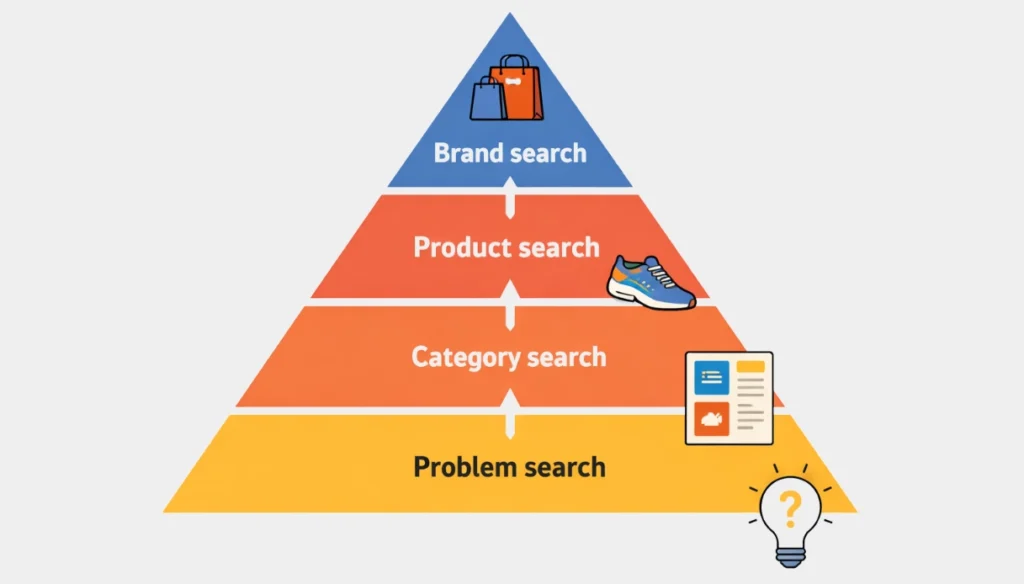
Each level corresponds to a different type of SEO page.
Problem-driven search: when user is looking for a solution
In the first level, the user is not yet looking for a specific product, but for a solution to a problem.
Examples of queries:
- how to choose running shoes;
- mattress for back pain;
- swimmingpool caps;
- ergonomic office chair.
At this stage , the research is still exploratory. The user is looking for information to understand what type of product they need, what features are important and what options exist. The pages that intercept this kind of question are often guides, editorial articles, comparisons and informative content.
Content creation is a very important level because this is where a lot of the demand arises. Many e-commerce completely ignore this phase, leaving traffic and visibility to blogs, magazines and comparators.
Category-driven search: when user identifies the type of product
In the second level, the user has understood what type of product he needs. The research becomes more concrete.
Examples:
- men’s running shoes;
- memory mattress;
- anti-fog swimming goggles;
- automatic coffee machine.
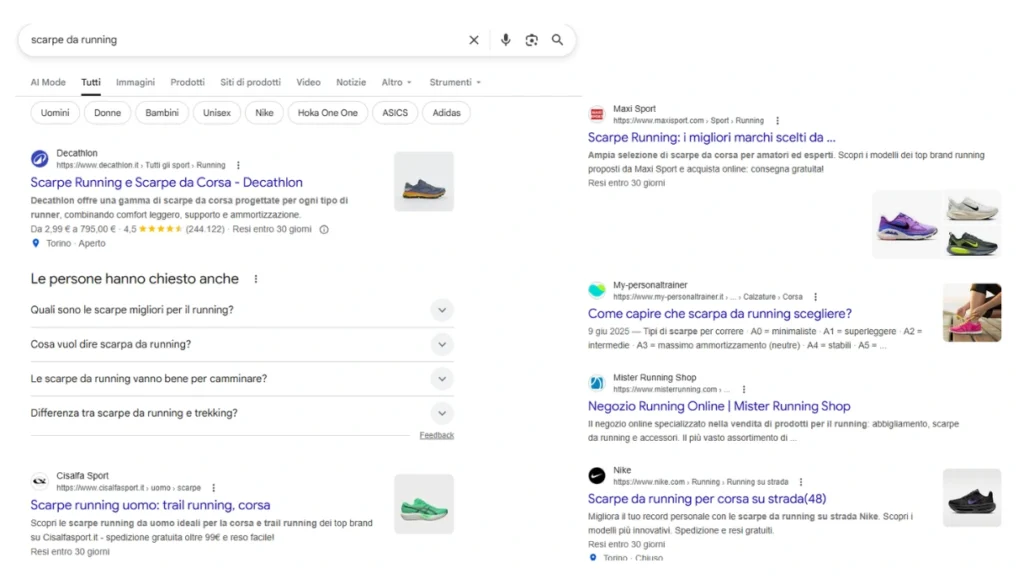
This is where category pages come into play. Many e-commerce websites treat categories as simple navigation tools, but for Google, they are much more than that. Categories are product discovery pages. When a query is generic, Google tends to show results that allow the user to compare multiple options, explore different products, filter and choose. For this reason, in the SERPs we often find e-commerce categories, marketplaces, comparators and buying guides.
From an e-commerce SEO perspective, category pages are often the most important pages on your website, because they intercept generic queries with the highest volume. Product sheets are used to sell, but categories are used to be found.
Product-driven search: when user seeks for a specific product
In the third level, the user has already identified a specific product and is looking for confirmation, or wants to buy
Examples:
- Nike Pegasus 40;
- Emma Original mattress;
- Arena Cobra Ultra.
These searches typically have lower volumes, but much stronger purchase intent. The pages that intercept these queries are the product pages.
From an SEO perspective, however, they present some pitfalls. Indeed, the search volume is often limited, the content can be similar to that of many other sites, and the product lifecycle can be short. For this reason, in e-commerce, most organic traffic rarely comes from products. Very often it is the categories that generate most of the visits.
Brand-driven search: when user has already chosen the brand
In the fourth level, the user has already decided on the brand and the searches become very specific.
Examples:
- Nike running shoes;
- Apple iPhone;
- Samsonite Cabin Suitcase.
In this case , the brand reduces uncertainty and guides the choice. The most effective pages to intercept this traffic are brand pages, i.e. pages dedicated to the products of a specific brand. These can also become important SEO hubs, especially in sectors where the brand has a strong weight in the purchase decision.
Catalog-driven vs demand-driven e-commerce
At this point, a fundamental difference emerges in the way many e-commerce websites are designed. We can identify two models: catalog-driven and demand-driven e-commerce.
Catalog-driven e-commerce
In the most popular model, the structure comes from the catalog.
This is process: products → categories → SEO.
First you upload the products, then you organize the catalog and only then you try to optimize the website for Google.
The problem is that the resulting structure often reflects the internal logic of the company, not that of the users. Categories are created to organize the catalog, not to intercept searches.
Demand-driven e-commerce
In the demand-driven model, the logic is the opposite. It starts with the research question.
The process becomes: question → query → categories → products.
First you analyze user searches, then you design categories, website architecture, and content.
In this way, e-commerce reflects the way people search, not just the way products are organized. E-commerce traffic does not come from the product, but from the need that precedes it.
The most common mistakes in e-commerce SEO
When an e-commerce is designed only from the catalog, some recurring errors often emerge.
Optimize only product pages
Many shops focus their SEO efforts only on product pages. The problem is that searches for specific products often represent only a small portion of the demand. Much of the traffic comes first, in informational and category queries.
Creating too many categories
Another widespread mistake is the proliferation of categories. The catalogue is often divided into many similar sections (e.g. “professional running shoes”, “race running shoes”, “competition running shoes”). When the categories become too many, there is a risk of fragmenting demand, creating weak pages and generating cannibalization.
Better to have fewer categories, but stronger.
Ignoring the information demand
A lot of research arises from needs and questions. Queries such as “how to choose a mattress”, “which running shoe for dirt roads”, “how to choose a coffee machine” can have enormous volumes. If an e-commerce does not create content to intercept them, it leaves room for blogs and comparators.
Category pages with no content
Categories often contain only a list of products. In reality, these pages can become very powerful SEO assets if they include useful descriptions, quick guides to choosing and links to related content.
Best practice for e-commerce SEO
Organizing the SEO of an online shop means above all working on architecture and demand from the early stages of design. Some practices, if done well, can make a big difference.
Building strong categories
Categories should be designed from user searches. Each category should start from a real demand and contain a sufficient number of products and useful content to guide the choice.
Use smart filters
Filters allow you to intercept many search variations. For example, for the category “running shoes” you can enter the filters “pronation”, “trail”, “cushioning” and “weight”. These combinations can become real SEO landing gears that intercept very specific long-tail queries, positioned in a segment of the funnel close to purchase.
Linking content and categories
Guides and articles should link to categories and vice versa. This creates a system in which content intercepts information demand and categories intercept commercial demand.
Using categories as semantic hubs
In a well-designed e-commerce , categories work as semantic hubs. A strong category is not just a list of products, but the center of a content cluster. For example, a category such as “running shoes” can be linked to “pronation running shoes”, “trail running shoes”, “light running shoes”, “guide to choosing running shoes”.
In this way , the category organizes the question and distributes relevance throughout the website.
In summary: e-commerce SEO arises from demand
Many e-commerce websites are designed starting from the catalog. After all, Google itself classifies information as a huge catalog. But from an SEO perspective, the process should be the opposite. Demand generates searches, searches define categories, and categories organize products. When a website’s architecture reflects the way people search, Google can interpret it better. And traffic grows naturally.
After all, product pages are used to sell, but it is the categories and demand that bring traffic.